
Adding and subtracting decimals can feel tricky at first, but with a little structure and a place value chart, your students will learn this important decimal skill in no time! In this blog post, I’ll walk you through how to do decimal addition and subtraction step-by-step.
Why Use Place Value Charts to Add and Subtract Decimals?
Decimals are all about place value! Helping students see tenths, hundredths, and thousandths lined up makes a big difference in their understanding. That’s why we’ll use a place value chart to keep everything neat and aligned.
Looking for extra practice about adding and subtracting decimals? Check out this comprehensive workbook that is all about Decimals and Fractions.
How to Add Decimals?
The most important thing to do when adding decimals is to line up the digits based on their place value. The easiest way to do this is to line up the decimals. Let’s walk through an example together.
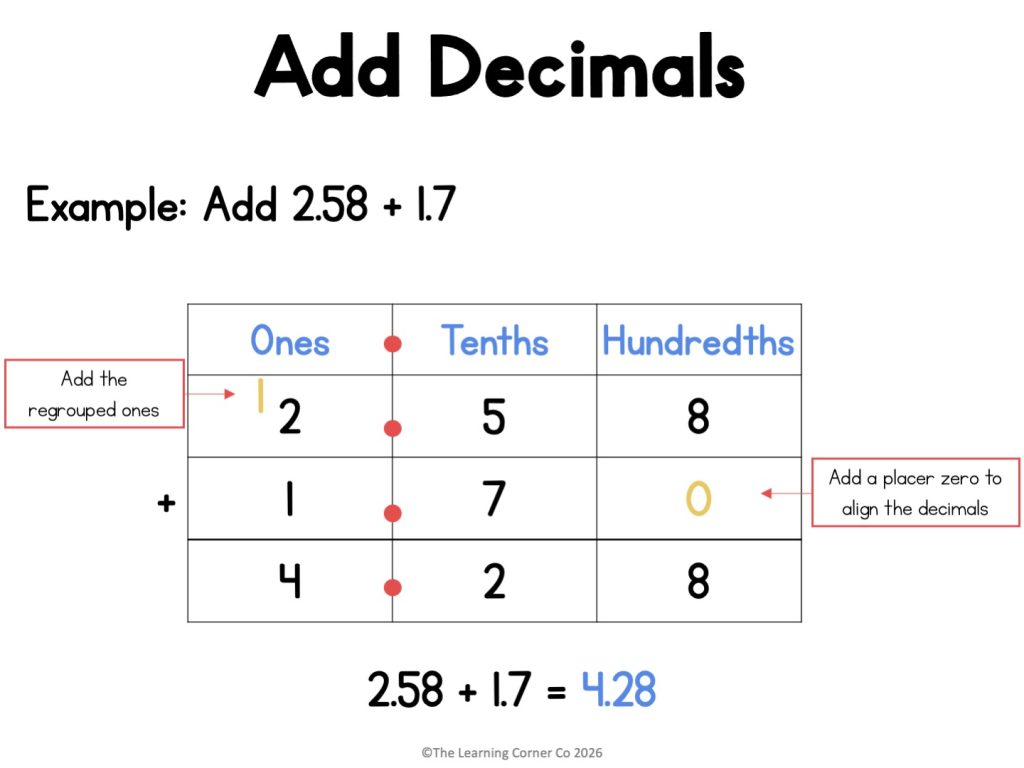
Example: Add 2.58 + 1.7
Step 1: Line up the decimals
Make sure both numbers are aligned in a place value chart. A good place to start is to line up the decimal points.
Step 2: Add zeros to make the decimal places match
Do you see a space after the digit 7? Add a zero to the right of 1.7, so both numbers have two decimal places.
This makes it easier to add each place value correctly.
Step 3: Add the hundredths
8 hundredths + 0 hundredths = 8 hundredthsWrite 8 in the hundredths place.
Step 4: Add the tenths
5 tenths + 7 tenths = 12 tenths
This is more than 10. This means that it is time to regroup.
12 tenths = 1 one and 2 tenth
Write 2 in the tenths place, and carry over 1 to the ones column.
Step 5: Add the ones
2 ones + 1 ones + 1 regrouped one = 4 ones
Final Answer:
2.58 + 1.7 = 4.28
How to Subtract Decimals?
Similar to adding decimals, the important thing to do when subtracting decimals is to line up the digits. Let’s try a subtraction example now.
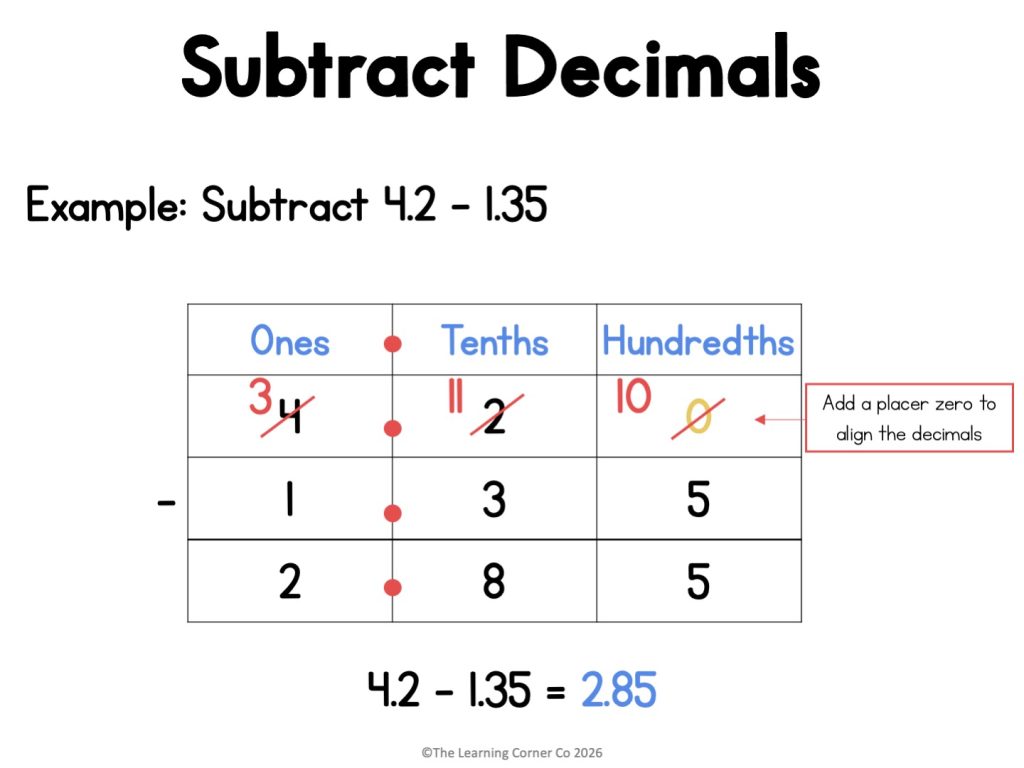
Example: Subtract 4.2 − 1.35
Step 1: Line up the decimals
We added a zero to 4.2 to match the number of decimal places. (This helps us subtract easily!)
Step 2: Subtract the hundredths
0 hundredths − 5 hundredths = Can’t do that! There are not enough hundredths to take away from.
Regroup from the tenths column:
- Change 2 tenths to 1 tenth
- Now you have 10 hundredths
10 hundredths − 5 hundredths = 5 hundredths
Step 3: Subtract the tenths
1 tenth − 3 tenths = Can’t do that! Again, there are not enough tenths to take away from.
Regroup again from the ones column:
- Change 4 ones to 3 ones
- Now you have 11 tenths
11 tenths − 3 tenths = 8 tenths
Step 4: Subtract the ones
3 ones − 1 one = 2 ones
Final Answer:
4.2 − 1.35 = 2.85
Teaching Tips
- Use visuals: Place value charts, base-ten blocks, or grids can help students understand where each number should go.
- Practice regrouping: Decimals are a perfect opportunity to review place value and regrouping!
- Try error analysis: Show students a problem with a common mistake (like not aligning decimals) and ask them to explain what went wrong.
- Incorporate real-world problems: Money and measurements are great contexts for decimal practice!
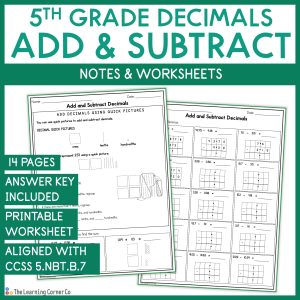
Ready to dig deeper into decimals? Check out our Adding and Subtracting Decimals Worksheet or Decimals and Fractions Workbook for a more comprehensive practice of the skill.
Adding and Subtracting Decimals Practice Worksheets
Still need more support for your decimal unit? I got you! Click on the images below to help ease your decimal unit.