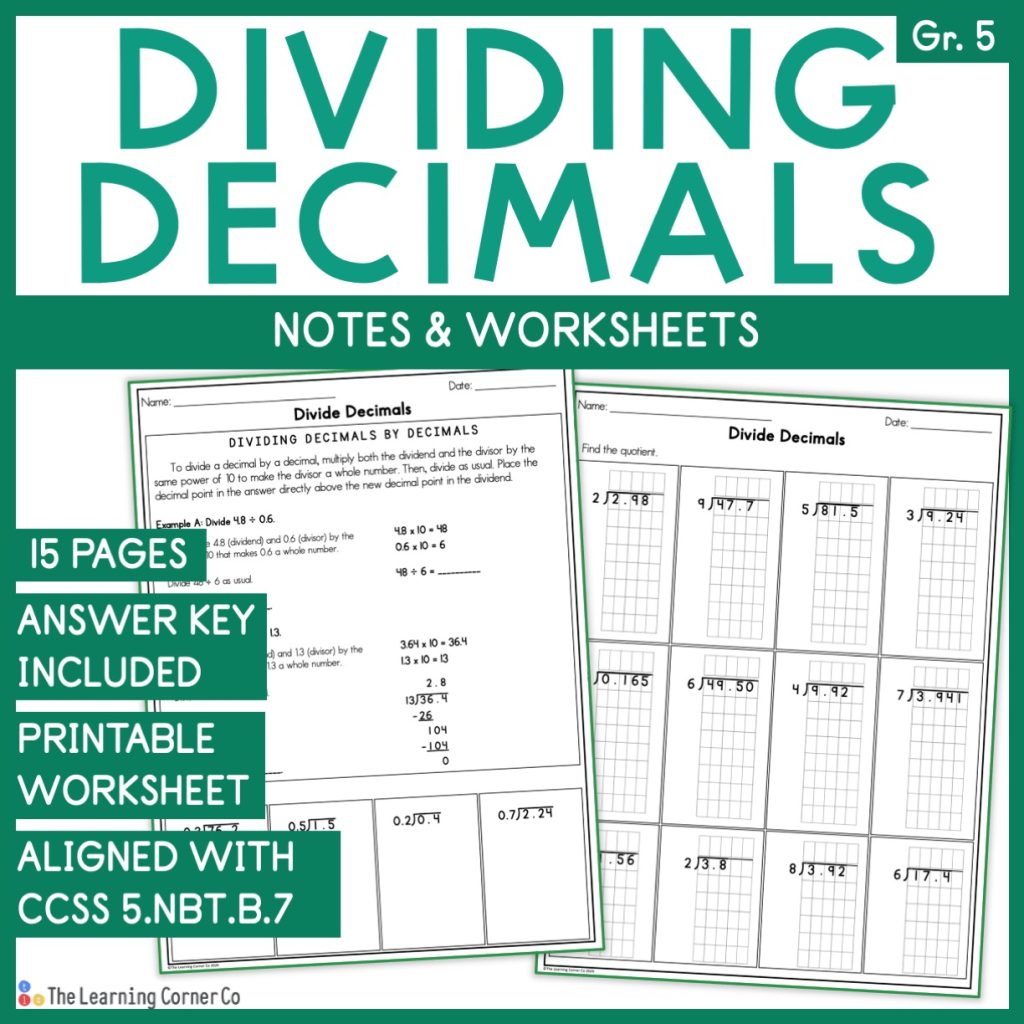

Dividing decimals is a key 5th grade math skill that builds directly on whole number division. Learning how to divide decimals can be broken down into three lessons: dividing decimals by whole numbers, dividing decimals by decimals, and writing zeros in the dividend when a problem doesn’t divide evenly. This step-by-step guide breaks down each topic with examples, plus an option to differentiate using base-ten blocks to help visualize what’s happening.
1. How to Divide Decimals by Whole Numbers
Dividing decimals by whole numbers is the first topic you want to practice when dividing decimals. The process is similar to dividing whole numbers, which makes it easy to understand. The only difference is placing the decimal point correctly in the answer. Let’s take a look at this example.
Divide 8.4 ÷ 4
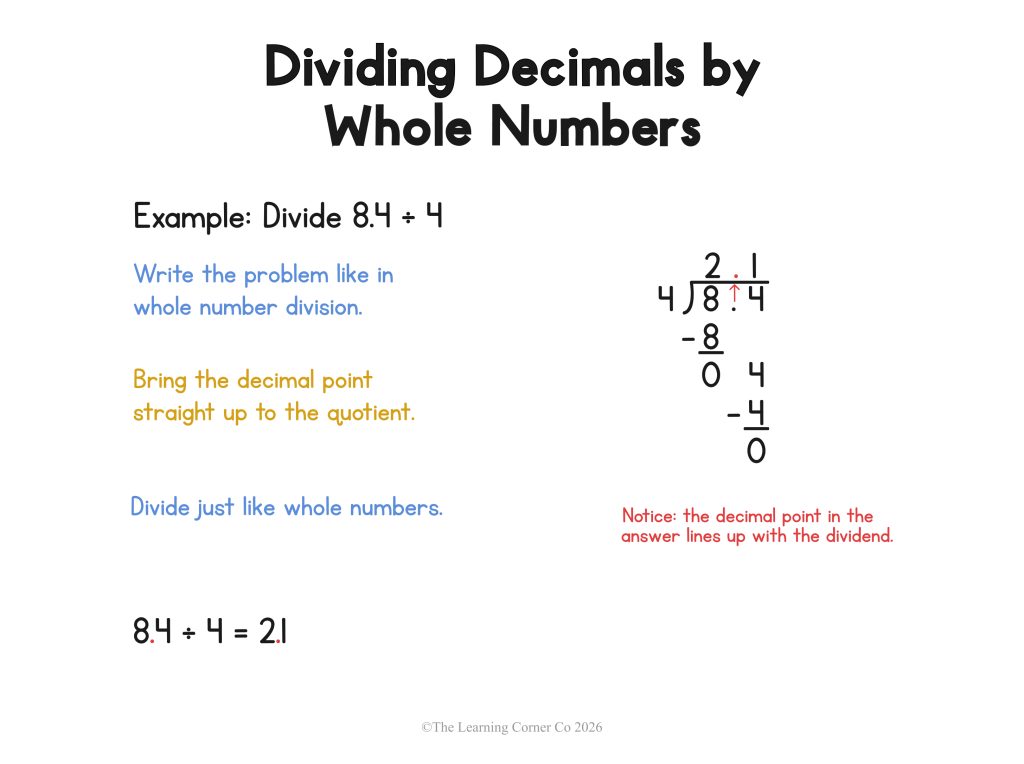
- Set up the long division just like a whole number problem.
- Bring the decimal point straight up into the answer space before dividing.
- Divide normally: 8 ones ÷ 4 = 2 ones.
- Bring down the 4, and divide. 4 tenths ÷ 4 = 1 tenths.
- The answer is 2.1.
Before dividing, a helpful habit is drawing a small arrow straight up from the decimal point in the problem to the decimal point in the answer. This prevents the most common mistake: forgetting the decimal point.
2. How to Divide Decimals by Decimals
Once you are comfortable dividing decimals by whole numbers, you can move on to dividing decimals by decimals. When dividing decimals by decimals, it is important to turn the divisor into a whole number first. This means that both the dividend and the divisor should be multiplied by the same power of 10.
Let’s take a look at this example.
Divide 3.6 ÷ 0.4
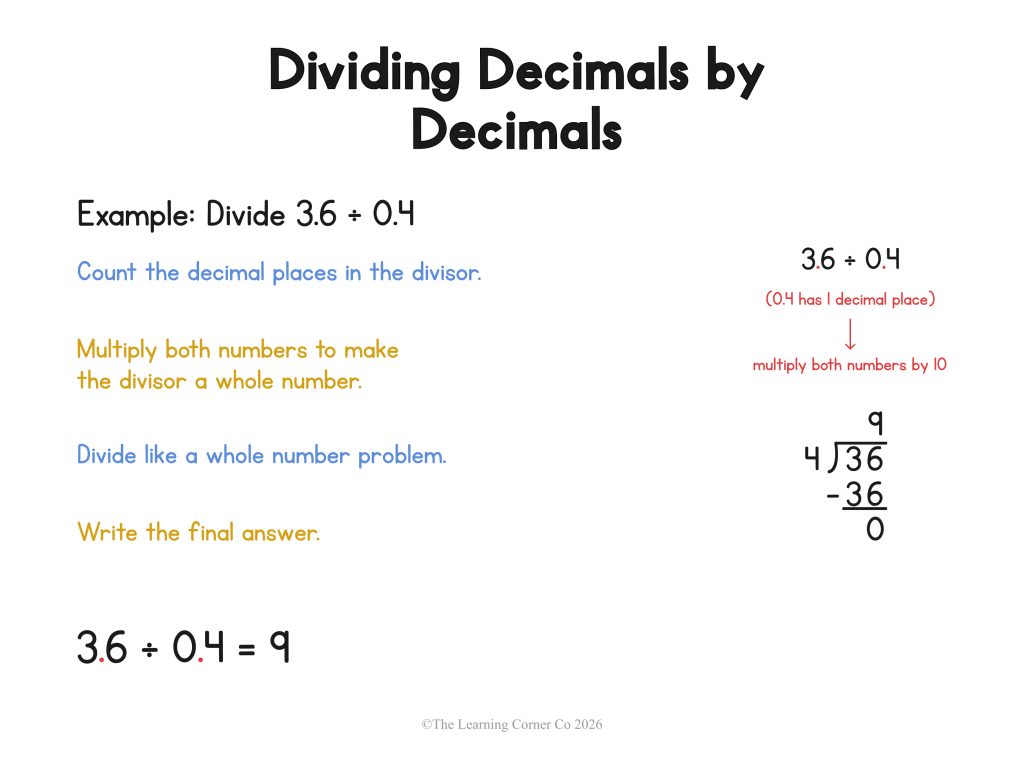
- Count the decimal places in the divisor. Here, 0.4 has one decimal place.
- Multiply both the divisor and the dividend by 10 to shift the decimal point that many places. 0.4 becomes 4, and 3.6 becomes 36.
- Divide the new problem: 36 ÷ 4 = 9.
- The answer is 9.
You might think that the answer should be a decimal since we are on the topic of decimals, but having whole number answers are natural. Think of it as having 9 groups of 0.4 in 3.6.
To help you remember to shift the decimal point for both the dividend and the divisor, a useful phrase to remember is “move the decimal point in both numbers the same number of places”.
Are you looking for a comprehensive workbook about decimals and fractions? Check out this Decimals and Fractions Workbook on Amazon!
3. When to Write Zeros in the Dividend
When dividing decimals, you will encounter remainders. In these cases, writing zeros in the dividend is needed whenever a problem runs out of digits. This allows you to divide the decimals further. (Don’t worry, writing zeros in the dividend won’t change the value of the number. Think: 1.5 = 1.50)
Let’s take a look at this example.
Divide 7.5 ÷ 6
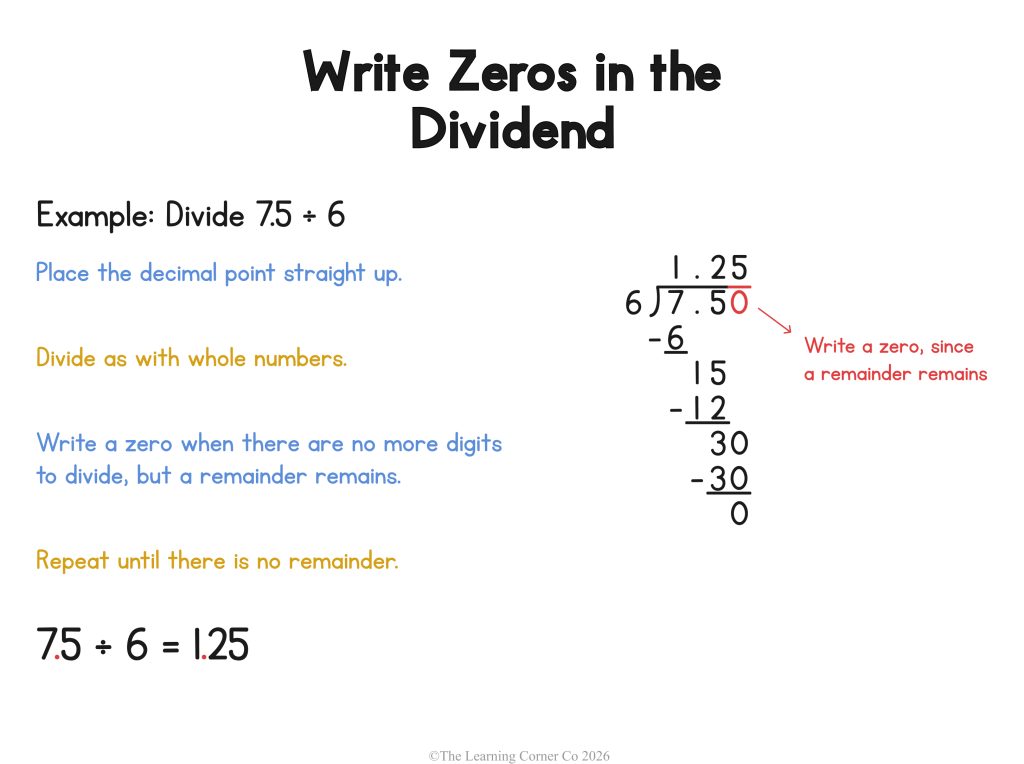
- Set up the division and bring the decimal point straight up.
- Divide 7 ÷ 6 = 1, with a remainder of 1.
- Bring down the 5 tenths: 15 tenths ÷ 6 = 2 tenths, with a remainder of 3.
- There are no more digits to bring down, but a remainder remains. Write a zero after the 5, turning 7.5 into 7.50.
- Bring down the new zero and divide: 30 ÷ 6 = 5, with no remainder left.
- The answer is 1.25.
Writing zeros in the dividend also applies to dividing decimal-by-decimal problems once the divisor has been turned into a whole number. Remember, you need to write zeros in the dividend when there are no more digits to bring down, and a remainder still remains.
4. How to Use Base-Ten Blocks to Divide Decimals
Base-ten blocks give a way to see what’s happening during decimal division, rather than only following steps on paper. Before dividing, assign a value to each block: the flat represents one whole, the rod represents one tenth, and the small unit cube represents one hundredth. Once you know what each piece is worth, you can model a division problem by sharing the blocks into equal groups.
Let’s take a look at this example.
Divide 1.5 ÷ 3
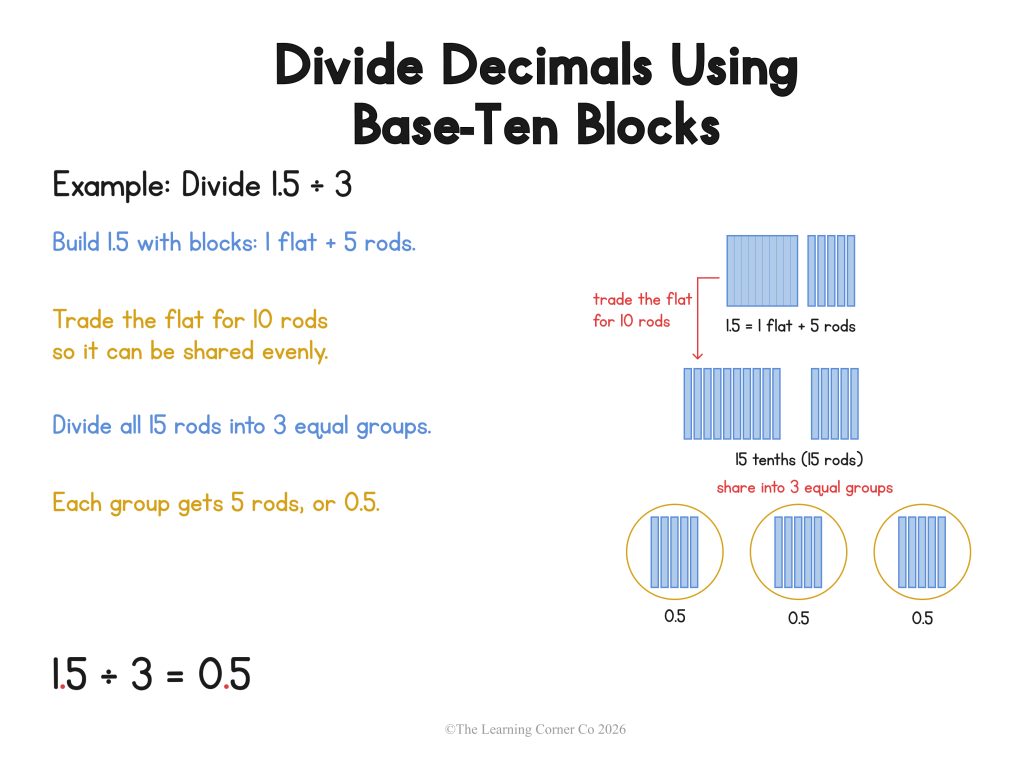
- Represent 1.5 with blocks: one flat (one whole) and five rods (five tenths).
- Since the flat can’t be split evenly among 3 groups trade it for 10 rods. There are now 15 rods total.
- Divide the 15 rods evenly into 3 groups. Each group gets 5 rods.
- Five rods is the same as five tenths, so each group holds 0.5.
- The answer is 0.5.
Trading a larger block for ten smaller ones whenever a piece can’t be split evenly is the same idea as bringing down a digit in long division.
Frequently Asked Questions
What is the first step in dividing decimals? The first step in dividing decimals by is lining up the decimal point in the answer lines up directly above the decimal point in the dividend.
How do you divide a decimal by a decimal? Multiply both the divisor and the dividend by the same power of 10 so the divisor becomes a whole number, then divide as usual.
Why do you add a zero when dividing decimals? A zero is added to the dividend whenever the digits run out but a remainder still remains, since adding a zero doesn’t change the value of the decimal and allows division to continue.
Decimal division becomes easier to learn once it’s broken into these three lessons. Pairing the written steps with a hands-on model like base-ten blocks is one way to differentiate and help students understand decimal division better.
Need more support with decimal division? Check out these practice worksheets and workbook to further help you with decimal division.