
Multiplying decimals can feel intimidating, but with a strong foundational skill on multiplying whole numbers and multiplication facts, students will realize that it is manageable. For this skill, clear step-by-step instructions and plenty of practice are key.
In this post, we’ll walk through three common points of decimal multiplication, using simple examples and explanations that work great for upper elementary students.
1. Multiplying Decimals by Whole Numbers
Multiplying decimals by whole numbers is the first step you want to take when multiplying decimals. The process is similar to multiplying whole numbers which makes it easy to grasp. Let’s take a look at this example.
Example: Multiply 4 × 0.3
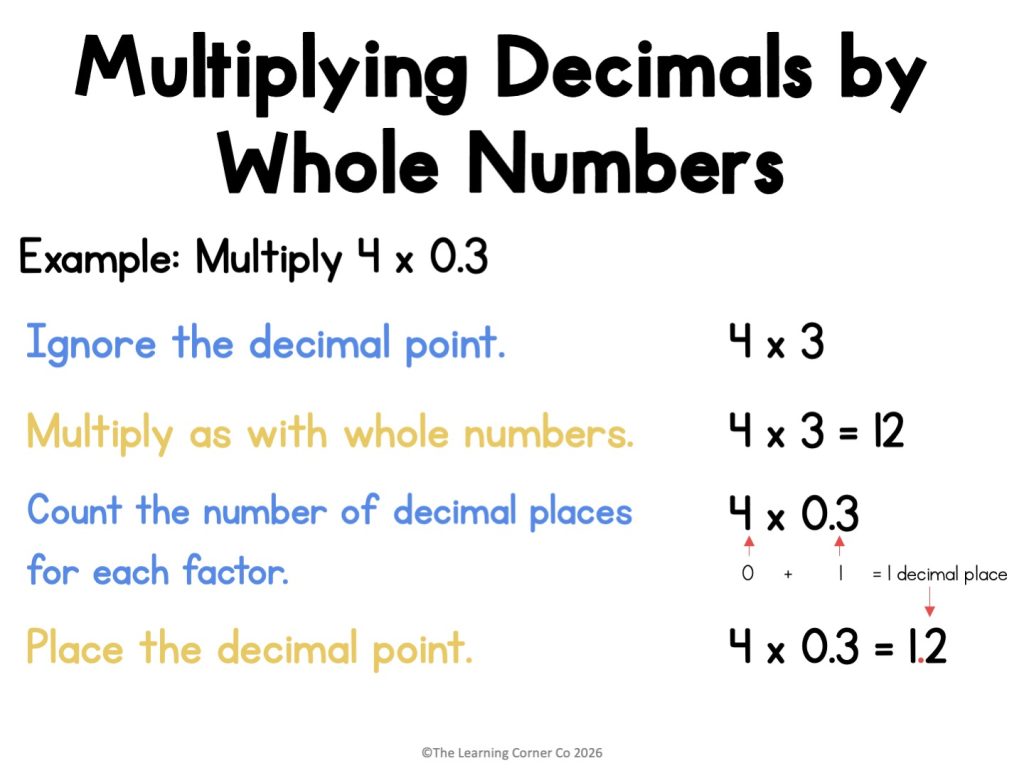
Step-by-step instructions:
- Ignore the decimal point and multiply like a whole number.
→ 4 × 3 = 12 - Put the decimal back by counting the number of decimal places given in the decimal 0.3.
Since 0.3 is three tenths, which has one decimal place, the product should also have one decimal place.
→ 4 × 0.3 = 1.2
Final Answer: 4 × 0.3 = 1.2
Why this works:
Students see whole numbers as “friendly” numbers, so it would be easier for them to multiply whole numbers first and place the decimal point later on.
2. Multiplying Decimals by Decimals
Multiplying decimals by decimals is still similar to multiplying whole numbers. The most important thing to do is to ignore the decimal points and place back the decimal point in the product. Let’s try an example.
Example: 1.5 × 0.3
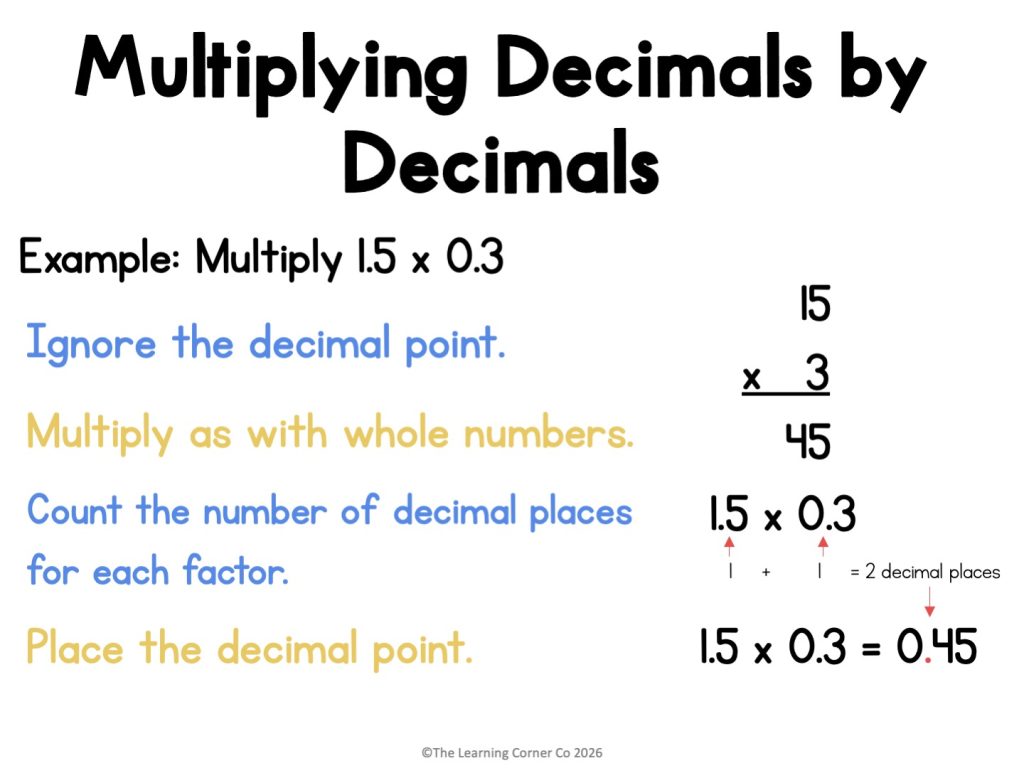
Step-by-step instructions:
- Multiply as if there are no decimals.
→ 15 × 3 = 45 - Count the decimal places in the original problem. Remember, the product should have the same number of decimal places for both factors combined.
- 1.5 has 1 decimal place
- 0.3 has 1 decimal place
- Total = 2 decimal places
- Place the decimal in the product. Since the factors have 2 decimal places combined, the product should also have 2 decimal places. You can write a zero before the decimal point. This would not change the product’s value.
→ 0.45
Final answer: 1.5 × 0.3 = 0.45
Why this works:
When multiplying decimals, you’re really finding three-tenths of one and five-tenths, which is less than 1, so the answer should be a decimal. Here’s a tip: Estimate first. Since 1.5 × 0.3 are decimals, having a whole number answer greater than the given decimals is a hint that you need to adjust where to place your decimal point.
3. Multiplying Decimals by Decimals: Writing Zeros in the Product
Sometimes, when multiplying decimals, the product does not have enough digits to place the decimal point. In these cases, you need to write zeros in the product.
Example: 0.2 × 0.4 = 0.08
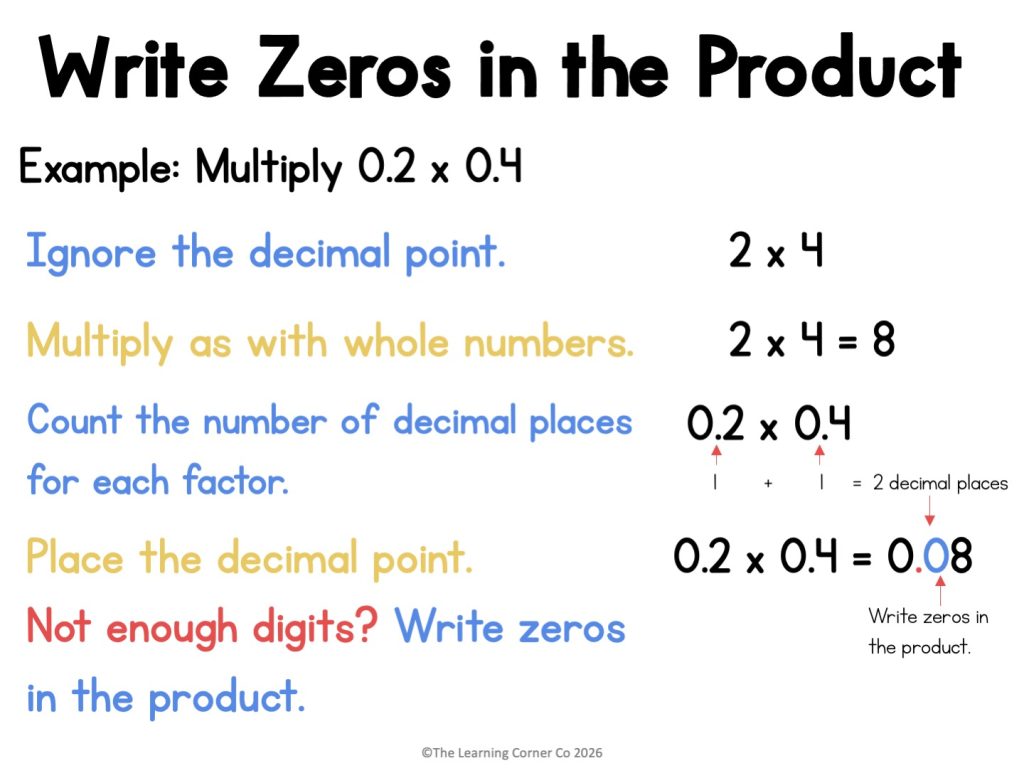
Step-by-step strategy:
- Multiply as whole numbers.
→ 2 × 4 = 8 - Count decimal places in the factors.
- 0.2 has 1 decimal place
- 0.4 has 1 decimal place
- Total = 2 decimal places
- Place the decimal point in the product. The product 8 does not have enough digits to place the decimal point. In this case, you need to write zeros in the product to have enough digits.
→ 0.08
Final Answer: 0.2 × 0.4 = 0.08
Common Errors When Multiplying Decimals
When you’re starting to multiply decimals, you will encounter common errors. Here are some that students usually make and how to fix them.
1. Forgetting to Place the Decimal
One of the most common mistakes is multiplying correctly but forgetting to place the decimal in the final answer. Students may stop after finding the whole-number product and forget that decimals change the value of the number.
How to fix it:
Teach students to always count the total number of decimal places in both factors before placing the decimal in the product. Remind them to ask themselves, “Does my answer make sense?”
Example:
12 × 0.4
Students multiply 12 × 4 and get 48, then stop there.
Ask your students, “Does the answer make sense?” Think 0.4 means 4 tenths, so this means the product should be less than 12. Remind them to place that decimal point.
2. Miscounting Decimal Places
Another frequent error is counting the decimal places. This often leads to answers that are either too large or too small.
How to fix it:
Have students circle or underline the decimal places in each factor before multiplying. This small visual step helps slow them down and check for accuracy.
Example:
3.2 × 0.7
Students multiply 32 × 7 = 224 and write 22.4.
Remind your students to count the number of decimal places and think, two decimal places mean that the decimal in the product should be in the hundredths place. Having only one decimal place means that the product is in the tenths place. To fix it, move the decimal point one more place to the left.
3. Skipping Estimation Altogether
Many students assume that multiplication always makes numbers larger, which can confuse them when multiplying decimals less than 1. Without estimating, students may not realize when an answer is unreasonable.
How to fix it:
Make estimation part of the routine. Even a quick “Is this answer reasonable?” helps students self-correct and think more deeply about the answer.
Example:
0.2 × 0.6
A student multiplies and writes 1.2.
Check with estimation:
Two-tenths of six-tenths should be much smaller than 1, so 1.2 can’t be correct.
The correct answer is 0.12.
With constant practice and a little nudge in the right direction, your students will surely master multiplying decimals in no time.
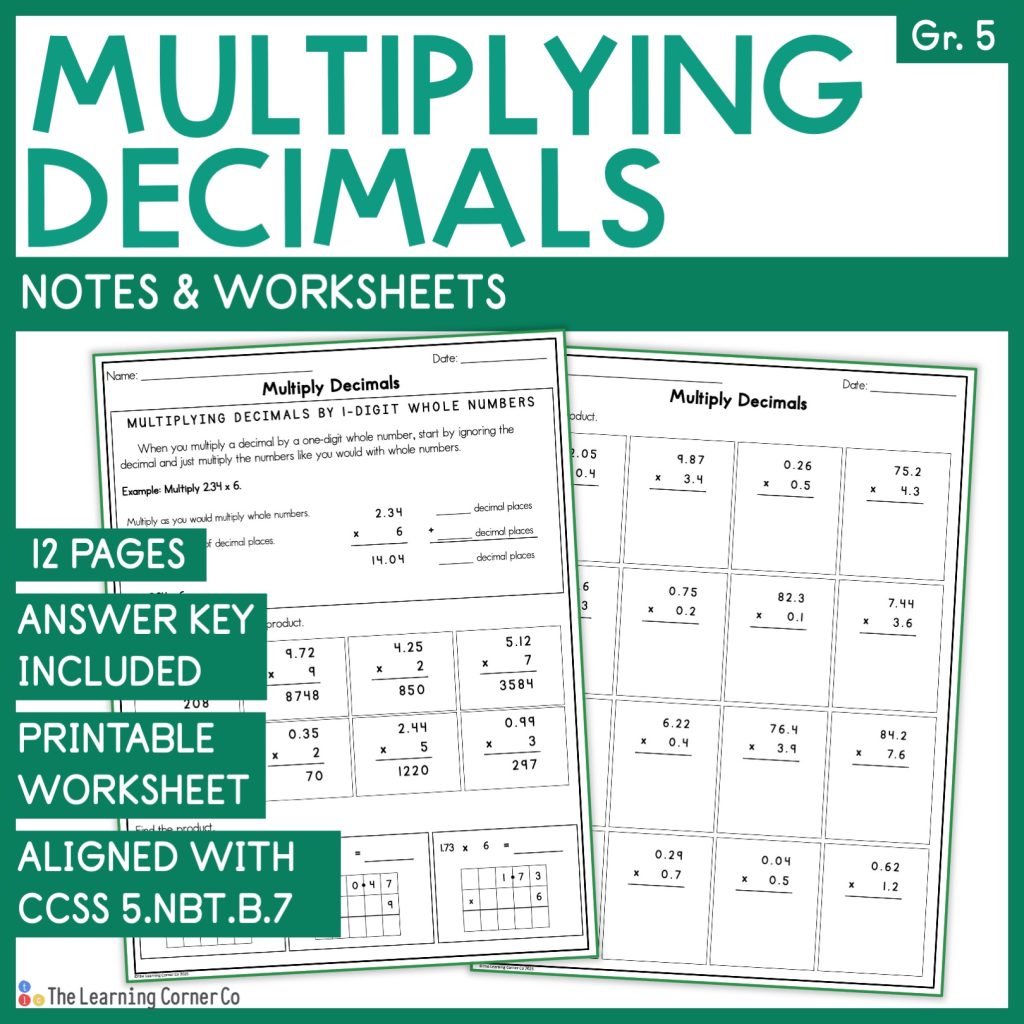
Need more support with multiplying decimals? These decimal worksheets and workbook were planned with these common errors in mind.